

Quick answer
The best time for whale watching in Mauritius runs from July through October, when humpback whales migrate north from Antarctic feeding grounds to breed in warmer tropical waters. July and August offer the highest frequency of sightings as pods pass closest to the Black River coastline. September extends the window with calmer seas and visibility above 20 meters, while October marks the tail end of the migration before whales return south.
Humpback whales travel over 5,000 kilometers annually between Antarctic krill fields and the warm breeding grounds off Mauritius, and their northward passage compresses into a three-month corridor. Between July and early November, an estimated 800 to 1,200 individuals pass through Mauritian waters, with the greatest concentrations recorded in the channel between Flic-en-Flac and Le Morne on the west coast. The migration is predictable in timing but not in daily distribution—pods move in response to water temperature gradients, krill blooms trailing the Mascarene Plateau, and breeding site competition. July and August represent the statistical peak for whale watching Mauritius best time planning. During these months, humpbacks linger in the shallower continental shelf waters where males perform competitive displays and females nurse newborn calves. Visibility conditions favor morning departures, when southeast trade winds have not yet built surface chop and underwater light penetration reaches 25 meters. Tour operators depart from Black River between 06:00 and 08:30, targeting the pre-9 AM window when whales are most active near the surface after overnight feeding dives. September offers a secondary advantage: the transition from peak winter to early spring reduces swell height along the leeward coast, and whale behavior shifts from competitive breeding displays to slower, more predictable travel as pods begin their southern return. Sighting rates remain above 70 percent through mid-September, then taper as October progresses and the migration empties. By November, only stragglers and juveniles remain, and excursion schedules shift to dolphin-focused itineraries. Weather patterns dictate day-to-day feasibility as much as migration timing. The Mauritius Meteorological Services records average wind speeds below 15 knots during early morning hours in August and September, creating the glassy conditions necessary for spotting blows and dorsal fins at distance. Cloud cover during these months sits below 40 percent, allowing sunlight to illuminate whales just beneath the surface. Rain fronts typically pass overnight, leaving mornings clear. Travelers booking around the whale watching Mauritius best time guide should prioritize departures within the first half of August or the first two weeks of September, when migration density and sea state align most reliably.
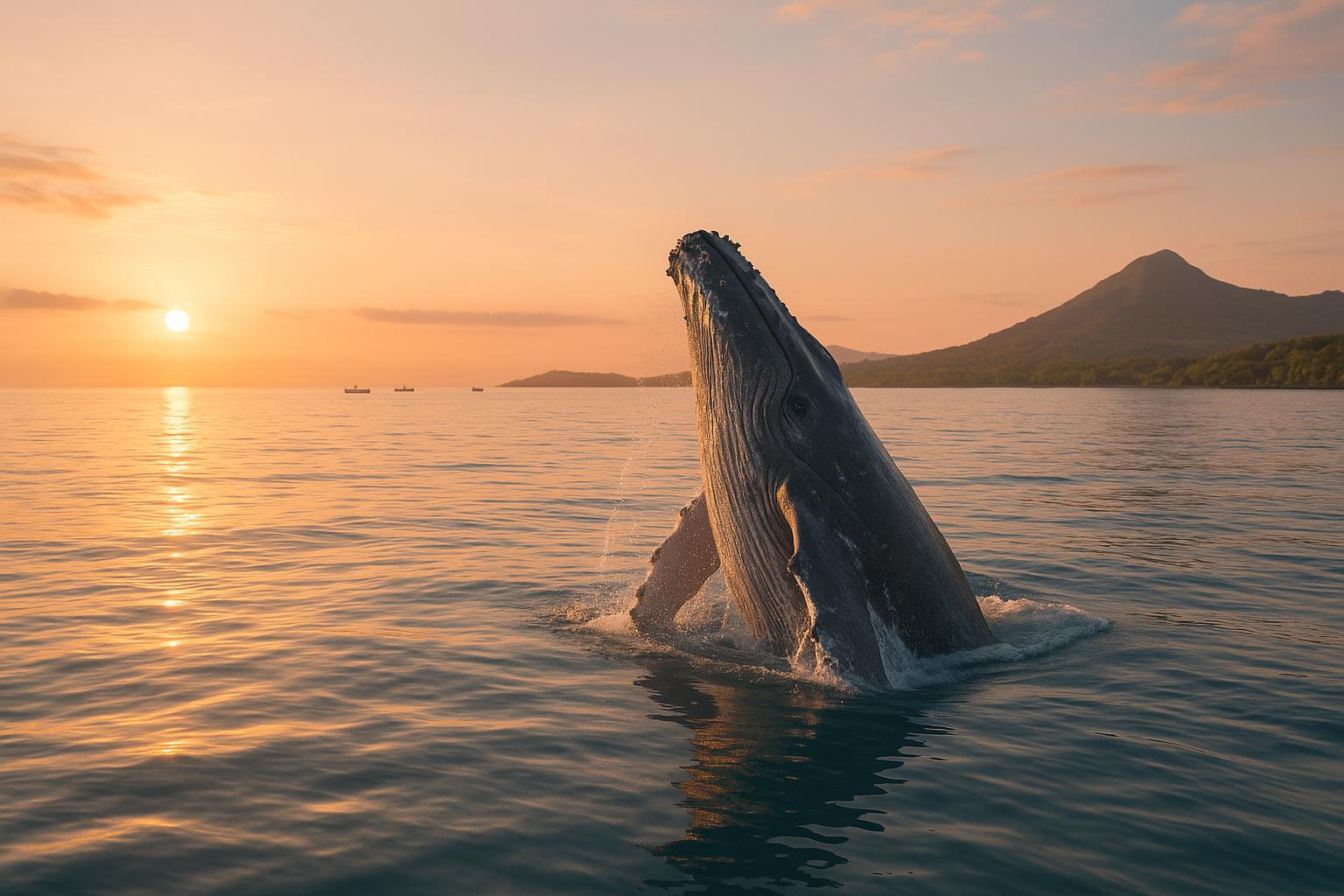
“Humpbacks linger in the shallower continental shelf waters where males perform competitive displays and females nurse newborn calves.”
Understanding the Whale Watching Mauritius Best Time for Sightings
The primary whale watching season in Mauritius occurs from June to November, when humpback whales migrate through the Indian Ocean. Scheduling excursions during these months offers the highest probability of sightings.
June to August
Moderate crowdsCooler, 20°C–24°C, moderate wind
Humpback whales begin arriving in these waters. Sea conditions can be variable during this period.
September to November
High crowdsWarmer, 23°C–27°C, calm seas
This period provides stable sea conditions and warmer temperatures. It is often cited as the peak window for sightings.
Early morning
Low crowds—
Departing early provides the calmest ocean conditions. This reduces surface chop, making it easier to spot marine life.
Verdict: For the highest success rate, plan your trip between September and November and prioritize early morning departures.
Daily Operational Hours for Whale Watching Mauritius Best Time Planning
Excursions depart daily from Black River to facilitate whale spotting in the Indian Ocean. Operations follow a consistent morning schedule throughout the week.
| Monday | 06:00–12:00 | |
|---|---|---|
| Tuesday | 06:00–12:00 | |
| Wednesday | 06:00–12:00 | |
| Thursday | 06:00–12:00 | |
| Friday | 06:00–12:00 | |
| Saturday | 06:00–12:00 | |
| Sunday | 06:00–12:00 |
Navigating to Black River for Your Whale Watching Mauritius Best Time Excursion
Whale watching excursions depart from Black River on the west coast of Mauritius. The most efficient way to reach the embarkation points is via the coastal B9 road connecting the southwestern region.
B9 coastal road to Black River
119 or 150 line to Black River station
Direct service to Black River harbor area
Admission and Tour Costs Regarding Whale Watching Mauritius Best Time
There is no official entrance fee for whale watching in Mauritius, as the activity takes place in the open ocean. Costs are exclusively determined by the private tour operators providing the boat excursions.
While ocean access is free, visitors pay market rates to private operators for vessel transport, with costs varying based on the excursion package selected.
Preparation Checklist for Your Whale Watching Mauritius Best Time Trip
Confirm these logistics before your whale watching excursion to avoid delays and maximize your time on the water.
-
Book your tour operator in advance — Peak season slots fill quickly, especially for early morning departures.
-
Bring motion sickness medication if prone — Indian Ocean swells can be significant even in calm months.
-
Pack reef-safe sunscreen and a wide-brimmed hat — Sun exposure is intense on open water with no shade.
-
Wear layered clothing and a windproof jacket — Mornings start cool; spray and wind chill amplify it.
-
Carry a waterproof bag for electronics and valuables — Sea spray reaches all areas of the boat during travel.
-
Confirm departure point and arrival time — Operators leave Black River promptly; late arrivals forfeit their spot.
-
Check cancellation and weather postponement policies — Rough seas occasionally force last-minute rescheduling.
Check availability
Frequently asked questions about whale watching mauritius best time
Everything you need to know about whale watching mauritius best time